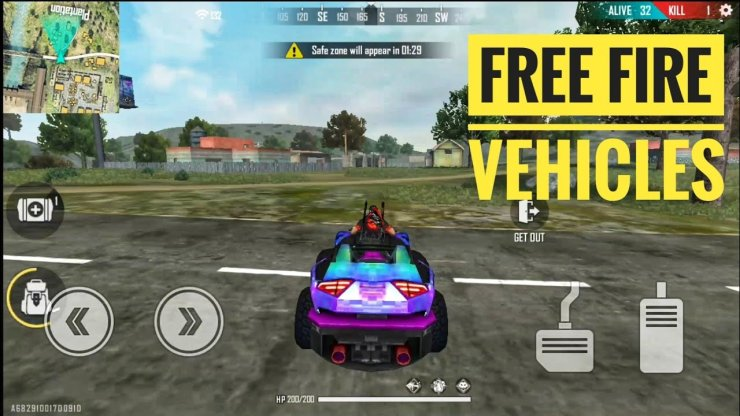
Stop Driving Wrong! Advanced Free Fire Vehicle Tips You Need
May 13, 2026
8 min read
Most players treat vehicles as a fast travel option. They hop in, drive across the map, and park in the middle of nowhere. That is exactly how you get third-party or sniped off your seat.
Vehicles in Free Fire are a decision-making tool. Used correctly, they control your rotation, force enemy mistakes, and keep your squad alive deep into the game. This guide breaks down exactly how to use them at an advanced level.
Why Vehicles Matter in Free Fire
A vehicle covers ground that would take a squad 30 to 45 seconds to run on foot. In a shrinking zone, that difference decides whether you get a comfortable position or fight your way in from the edge.
Compete on ZP Battle Zone
Apply what you just learned
Join 35,000+ Pakistani players competing in live Free Fire tournaments every week. Verified results, fair play, organized competition.
The tradeoff is noise and visibility. Every vehicle engine is loud. Enemies within range hear you coming and have time to set up before you arrive. That is the core tension you need to manage every time you consider getting behind the wheel.
The goal is not to drive everywhere. The goal is to drive at the right moment, with a clear exit plan, and stop before you give your position away.
When to Use a Vehicle
The best time to use a vehicle is in mid-game when the zone is pulling far from your current position, and running across open ground would expose you.
If the next safe zone is 500 meters or more away, a vehicle is almost always the correct call. Running that distance in the open invites snipers, third parties, and zone damage. A vehicle gets you there in seconds and keeps your HP intact for the fight that comes after.
Use a vehicle after a fight as well. When your squad just cleared a building and hears another team rotating in, a fast exit prevents a bad third-party situation. You take the fight on your terms later rather than absorbing pressure from two directions at once.
The other smart window is early zone transitions when teams are still spread out and not fully set up. Noise matters less when everyone is still looting and repositioning.
When Not to Drive
Vehicles become a liability when you are already in or near the final zones. Engine noise in the late game tells every remaining squad exactly where you are. You lose the most valuable thing in endgame play, which is information advantage.
Do not use a vehicle when enemies already know your position. If a squad just pushed you or fired on your location, getting into a vehicle locks you into a path they can predict. You become easier to track, not harder.
Avoid vehicles after the third zone. They expose your position and force you into predictable movement. From that point, rely on natural cover such as ridges, trees, rocks, and buildings to move. Use Gloo Walls to cross open patches if needed.
Open field driving is also high risk, regardless of the zone. Vehicle sounds attract enemy attention. Use them strategically, not out of habit. If you are driving without a purpose or a destination, you are burning noise and position for no benefit.
How to Rotate Safely in a Vehicle
The rotation does not end when you reach the zone boundary. It ends when your squad is dismounted, behind cover, and ready to fight. That exit point is what most players never plan.
Before you get into a vehicle, identify where you are going to stop. Always have a vehicle exit plan. Know the nearest vehicle spawn and your dismount point before you commit to the rotation. Stop near a building, a rock formation, or a ridge, not in the middle of a field.
Drive at an angle when approaching populated areas instead of heading straight in. A direct line is predictable. A curved approach from the edge of the terrain lets you see threats before they can react to the engine noise.
Dismount before you reach the target location by about 50 to 80 meters. Parking at the destination means your noise signature arrives with you. Stopping short and moving on foot gives you a few seconds of silence before the engagement.
If your squad is in a jeep or truck together, the passenger should be scanning for threats continuously while the driver focuses on route selection. Do not both be looking at the same thing.
Vehicle Combat Tricks Pros Use
A vehicle is not just transport. With the right timing, it is a weapon, a decoy, and a cover tool.
Ramming
Ramming is situational but effective. If an enemy is in the open, distracted by a fight, or caught reloading, driving at full speed into them deals damage and breaks their positioning. Do not use this if they are behind cover or if other squads are watching. The vehicle takes damage too, and a destroyed vehicle in the open leaves you exposed.
Vehicle as bait
Vehicle as bait works well in late-game transition zones. Park a vehicle visibly in an open area or near a building while your squad holds a covered position nearby. Teams that see the vehicle will investigate or shoot at it, revealing their location. Let them come to you.
Dead vehicle as cover
Dead vehicle as cover is an underused trick. A destroyed vehicle stays on the map as a hard object. If you have burned a vehicle near a choke point or building entrance, it becomes instant cover that was not there before. Place yourself behind it and use it like any other piece of terrain.
Keep in mind that weapons like the M82B or any high-calibre sniper can damage and destroy vehicles quickly. Do not rely on a vehicle for cover against squads you know are carrying sniper rifles.
Team Vehicle Roles
In a squad, everyone in the vehicle should have a role before the tyres start moving.
The driver focuses entirely on route selection and positioning. Their job is to pick the safest path, avoid predictable lines of movement, and identify the exit point. They should not be watching enemies or preparing to shoot.
The passengers scan for threats on both sides and communicate what they see. At least one passenger should have their weapon ready to fire the moment the vehicle stops. The first few seconds after dismounting are when your squad is most vulnerable.
In squad mode, keeping all team members in the same vehicle leads to better rotations and longer survival. Splitting the squad between two vehicles doubles your noise signature and creates coordination problems if one group gets engaged.
Smart Character Synergy for Vehicle Play
If vehicle rotations are a core part of your strategy, your character setup should support that playstyle.
Misha increases vehicle speed and durability, making her excellent for fast rotations. Alok restores HP and increases movement speed, which helps during and after rotation fights. Kelly increases sprint speed, useful for repositioning quickly after dismounting.
For squad play, pairing Alok’s healing with a speed character like Kelly gives you a well-rounded rotation setup. One player sustains the team during a contested rotation while another ensures fast repositioning once you are on foot.
You do not need all four squad members running the same type of character. One mobility character and one healer in the rotation is usually enough to cover both needs without sacrificing combat effectiveness.
Common Vehicle Mistakes
These are the patterns that get players eliminated when they have a winning position.
Driving too long in the open. Every second spent in a visible field is a second enemies spend lining up a shot. Get in, cross the danger, get out.
Jumping out late. Players hear a threat and freeze instead of dismounting immediately. Practice dismounting the moment danger is confirmed, not after you take the first hit.
Parking in predictable spots. Leaving a vehicle at the main entrance of a building or directly behind a rock tells every squad where you are. Park offset, away from obvious positions.
Using a vehicle in the final circle with no fallback plan. If the last zone is small and you drive in, every team on the map hears you. Have your Gloo Walls ready and a compound or terrain piece to push toward immediately on exit.
Ignoring what enemies are carrying. Check the kill feed and audio. If sniper fire has been consistent in your area, a vehicle rotation is riskier than usual. Adapt accordingly.
Pro Vehicle Tips You Can Use Right Now
Apply these in your next ranked session, and you will immediately see a difference in how your rotations play out.
Only carry a vehicle when it solves a specific pathing problem. If you are already inside the safe zone with good cover nearby, there is no reason to create noise by driving around.
Use vehicles to force zone control, not to explore. Getting to your intended position before other teams do gives you time to set up. That is the real value of a fast rotation.
Always exit with cover ready. Before you dismount, identify what you are getting behind. One Gloo Wall placed immediately after dismounting can mean the difference between a controlled engagement and a clean elimination.
If a fight starts near your parked vehicle, consider whether destroying it yourself is smarter than letting enemies use it for cover or as a landmark to call your position.